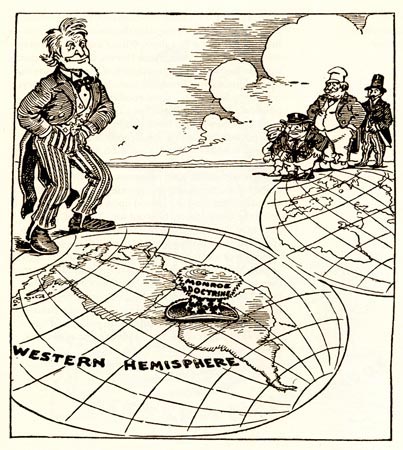
Journalists have long examined the current Trump administration as a return to “might makes right” form of policymaking. Already in the beginning of the term, the New York Post published a front cover with a provocative title “The Donroe Doctrine: Trump’s vision for hemisphere”. The title was clever wordplay of the 19th century Monroe Doctrine which stated that European powers should stay away from American sphere of influence and the US would in turn stay away from European affairs. Although the 21st century administrations have distanced themselves from the Monroe Doctrine, it was still used by several post-war presidents to justify their actions during Cold War. As such, it is no enormous step to suggest that the Trump administration is constructing its own form of the doctrine.
During Autumn, the idea of the Donroe Doctrine caught wider interest as the US increased its pressure on Latin American countries. The measures to control the region went beyond tariffs and sanctions to include economic bailouts, threats, and even bombing campaigns. In November, the New York Times concluded that the Western Hemisphere had indeed returned as a central theatre for the US foreign policy in a great revival of the Monroe Doctrine. The change of focus marked a sharp departure from the past and a victory for military hawks, like Secretary of State Marco Rubio, who have long demanded stronger position against the leftist governments of Latin America. Instead of claiming to protect the rule-based order around the globe, the Trump administration appeared to openly prioritize foreign issues at America’s “backyard”.
Surprisingly enough, Trump himself seemed to confirm the existence of the Donroe Doctrine following the capture of Venezuela’s president. In his hour-long press conference, the president proudly presented the abduction as an example of the Donroe Doctrine and claimed to have gone beyond the original Monroe Doctrine which was “forgotten” by the previous administrations. However, by approving the usage of the term, Trump also appears to go against several of his own election pledges which promised to stay out of foreign conflicts and provide peace. The doctrine proves the point of the critics who have viewed Trump as a salesman without any respect for international law. Altogether, it seems outstanding that there was a period when he was being nominated for the Nobel Peace Prize.
From Monroe to Donroe
History can give clues about the potential direction of the Donroe Doctrine. In the beginning of the 20th century, the Monroe Doctrine was used in its extreme form by Thedore Roosevelt who argued that the US should always be allowed to interfere in the misbehaviour of any Latin American country. Although the Monroe Doctrine was created to prevent European powers from interfering in the Latin America, Roosevelt extended the idea to justify the US’s own interventions in the Western Hemisphere. The Great White Fleet, consisting of 16 battleships, was used to demonstrate the US military strength and warn adversaries of potential consequences. Thus, the Roosevelt’s foreign policy extended close to the imperialism that was traditionally exercised by European powers.
The foreign policy of the Trump administration has a familiar echo with the times of Roosevelt. Like Roosevelt, Trump believes that the military should be strong enough to squash any conflict before escalation. Adversaries need to be constantly reminded of the might of the US forces through threats and displays of power. If warnings are not enough, the military must return a new order, like the US did in Venezuela and might soon do in Iran. Then again, Trump lacks one crucial component that was available for Roosevelt: popular support. Roosevelt was constantly pushed to go even further by expansionists who were encouraged by a successful war against Spanish in Cuba. Today by comparison, Americans are frustrated by all kinds of warfare, since campaigns against terrorism proved largely unable to deliver their aims. Moreover, the contemporary Latin America has already industrialized and is far from a barbaric region that requires guidance of a more civilized nation, as Roosevelt used to argue. The mutual success of Americas benefits from cooperation and trust, not from unnecessary lecturing about a natural order.
Global Consequences of the Doctrine
In the aftermath of Maduro’s abduction, China and Russia might feel nervous. Trump seemed happy to show how little neither of them could do to protect their close trading partner. Now the president is threatening other governments from Columbia and Mexico to Greenland and Iran, as a signal of growing appetite for imperialism. His actions are forcing other superpowers to rethink their geopolitical priorities, particularly in regions without any singular dominant power, such as the Arctic area, the Middle East and sub-Saharan Africa.
As months turn to years, however, the US’s neglect for international order begins to benefit its adversaries. Authoritarian powers are not afraid to use obstructive methods against their enemies or even against their own people when necessary. For them, the Donroe Doctrine essentially provides a “free-from-jail”-card from international treaties which they have never respected in the first place. If Xi and Putin can argue, like Trump, that only their personal moral should be the guiding principle for the well-being of their people, there is only little limits for their ambitions.
The Donroe Doctrine clearly helps China’s claims regarding Taiwan and Russia’s claims regarding former Soviet territories. If the US can pull out the regime of its neighbouring country, why China and Russia should not be allowed to do the same for their neighbours? In fact, authoritarian powers could also go much further with their demands. Following Trump’s recent behaviour, they can make claims of any region of geopolitical interest and purely fabricate the need for interference. The only requirement is that they have a strong enough military to overtake the region and to defeat potential opponents.
Trump views that the US has an upper hand in the world of might makes right. Indeed, the US still has the world’s largest army and continues to be located conveniently in its own continent far from superpower conflicts. Then again, the US can also be seen as an increasingly difficult platform whose games are becoming too expensive and dangerous. China has already largely decoupled itself from the US and is still able to grow by trading with the rest of the world. For Europe, it makes no sense to go downhill with the US when the alternative is to participate in the international institutions and to become a respected democratic superpower. As such, Trump’s drive is reducing the US’s power on the global stage and encouraging former friends of the US to create alternative forms of alliances.
It must be noted that the ideas behind the Donroe Doctrine have been pushed outside the White House for several years, if not decades. The development marks a remarkable, albeit miserable, renewal of a widespread fascist mindset which argues that the most powerful should and must take over the others in a rivalry of the fittest. Today it is explained through geopolitical competition rather than through need for Lebensraum, but the actual methods are not too different from the past. The enemies are vilified, threatened and punished without any regards to justice. The most striking examples of this can be already found from Gaza and Ukraine whose conditions are remarkably similar to those during the World Wars. It might not be the direction that President Trump is intending to lead his country into, but he is certainly encouraging other leaders to take steps ahead.
 saukotuksia
What’s your view?